
As soon as we are officially free from the limitations imposed by Covid-19, I would like to do a beautiful bike excursion that I have not done for a long time, that is, starting from my home in the east Pavia area and, between cycle paths and Vernavola Park, entering the cycle path along the Naviglio Pavese that will take me to the Navigli of Milan, then going for a walk in Corso San Gottardo and maybe doing a little shopping (even a NON-fashion victim like me, after more than two months of confinement, wants to window shop, buy beautiful things!!).
Pedaling happily, I will greet the Certosa di Pavia from afar, I will observe the fishermen casting their lines while sitting along the Naviglio, I will admire the monumental poplars and, if the day is particularly clear, I will be able to enjoy a few glimpses of distant snow-capped alpine peaks, down there to the northwest, before finally entering the city, the always fascinating Milan! Older Milanese can confirm that the area of Corso San Gottardo, a stone's throw from the Darsena (the ancient port of Milan), the Naviglio Grande, the Pavese and the remains of the Spanish walls, was known as the Borgh di Formaggiatt.
Imagine when the large barges still came from the countryside around Milan, loaded with sand, bricks, stones, marble, wood, coal and also lots and lots of milk that was transformed into tasty cheeses right there, in the Borgh di Formagiatt. The barges came from the Naviglio Pavese, made navigable from 1818 and so soon the houses and cellars along Corso San Gottardo were transformed into "casere" or places for processing and aging cheeses, tasty gorgonzola and excellent grana padano.
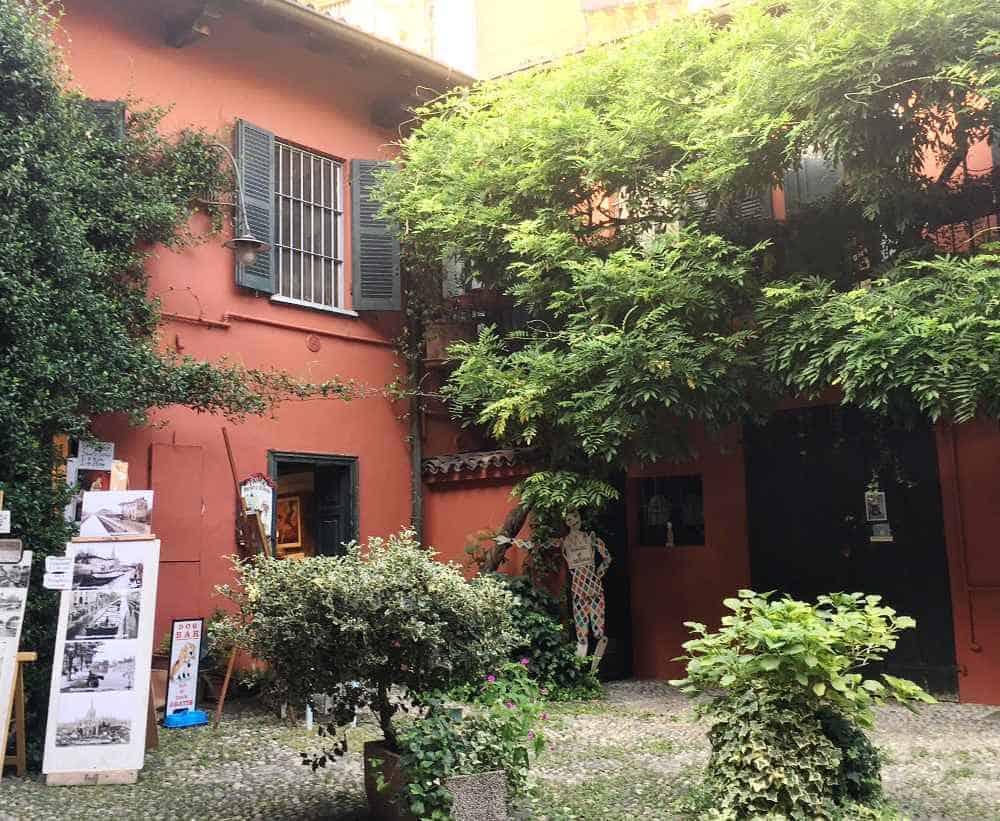
The wheels aged and were gradually moved to the premises towards the Corso until they arrived, once "mature", at the shops along the street giving, not only to the neighborhood but also to its inhabitants, the typical acrid and unmistakable smell of cheese! We can still guess how these buildings that became "casere" were made today, just enter one of the open doors that hide the famous "railing houses", with courtyard, warehouses, workshops and shops in the deep internal courtyards and the small apartments with shared balcony on the upper floors.
Of course, the area was also full of shops of all kinds, especially for the processing of iron and terracotta, and taverns, including one of the most famous, the Osteria del Noce, where, in the nineteenth century, poets and artists, the so-called "Scapigliati", usually met. These few lines already give an idea of the lively and popular atmosphere that could be felt along Corso San Gottardo and throughout the Navigli area, which even today remains a Milanese neighborhood definitely worth visiting and not only for an aperitif, although, of course, my day on the bike will end like this, on board the Naviglio drinking a good Spritz Campari!
And speaking of Milanese places not to be missed, below you will find my podcast in which I tell you about some glimpses of Milan, bearing in mind that the best way to discover famous places and lesser-known corners of a city is to visit it with a Licensed Tourist Guide! A small investment that will give you great satisfaction!